
One reference for the programme
Visitors can find the research purpose, work packages, people, and updates within one website.
{ Project / Live }
A public-health research website for ChangePHC Georgia, bringing programme information, work packages, partners, and project updates into one place.
{ At a glance }
{ Business outcomes }
Visitors can find the research purpose, work packages, people, and updates within one website.
Dedicated pages let visitors explore individual activities after understanding the overall programme.
Partner attribution, community involvement, capacity strengthening, and news each have a clear place.
{ Context }
ChangePHC examines primary health care reform in Georgia. Its public website needed to introduce a complex collaborative research programme to visitors with different levels of familiarity, then provide clear routes into individual activities, people, and updates. The challenge was to make the overall programme understandable without compressing all its specialist material into the homepage.
{ Role & implementation }
I created the ChangePHC website, with the homepage design developed in Figma. My contribution connects the programme’s public introduction with a page structure that helps visitors move from an overview into more detailed research and collaboration content.
{ The solution }
The website organizes programme information into dedicated areas for work packages, partners and team, community engagement and involvement, capacity strengthening, and news. The homepage establishes the research context and introduces these routes, while individual pages provide room for more detailed material.
{ Technical decisions }
A layered content structure lets visitors begin with the programme’s purpose and choose how deeply to explore. Research activities have their own pages, while community involvement and learning content remain visible alongside them. Partner information and funding acknowledgments have space within the institutional presentation without overwhelming the programme introduction.
{ Engineering detail }
The homepage introduces the programme and its focus areas. Dedicated work-package pages then break specialist material into sections, giving each strand of research a clear place within the wider website.
{ Engineering detail }
Partner and team content identifies the institutions and people involved in the programme. The website accommodates attribution and acknowledgments as part of its public presentation.
{ Engineering detail }
Dedicated community engagement and capacity-strengthening pages describe activities beyond research methods alone. The website communicates the programme’s work; the website-development role is distinct from conducting its research or engagement activities.
{ Engineering detail }
A news area provides a place for programme updates alongside the more stable research and institutional pages. This gives visitors a route to follow activities over time.
{ Technology & architecture }
| Layer | Technology |
|---|---|
| Homepage design | Figma |
| Public website | WordPress |
| Page implementation | Elementor |
{ Delivered capabilities }
ChangePHC has a live public website that brings programme information and updates into one place. Stakeholders have a shared reference for understanding the research, exploring its activities, and following programme news.
{ Scope }
This case study covers the ChangePHC website as a distinct project. Programme research, institutional authorship, and partner activities belong to the programme and its contributors. No research-impact, policy-impact, traffic, or engagement improvement is claimed.
{ Keep exploring }
{ Screens & walkthrough }
{ Today }
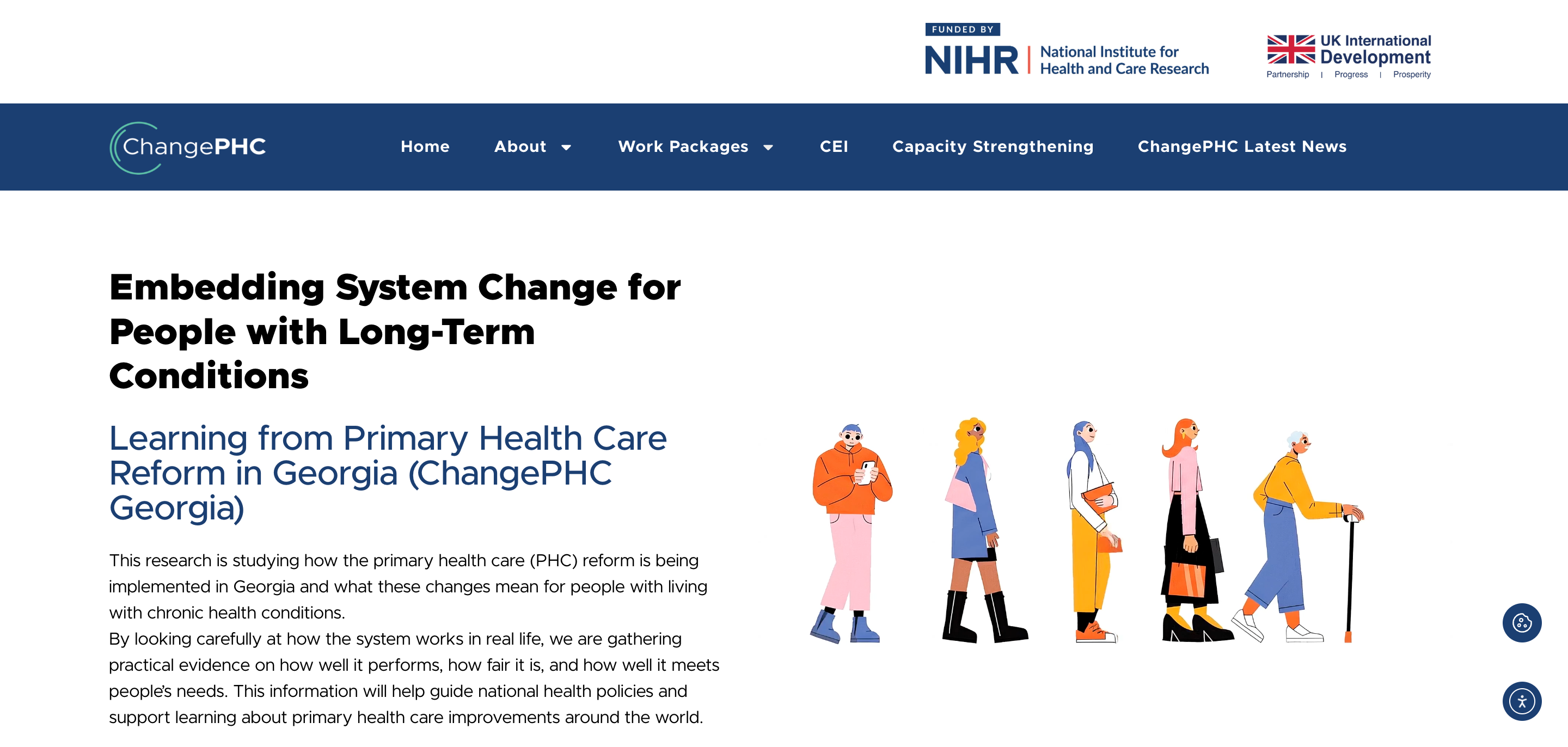
The public website is live at changephc.org, with programme information, work packages, collaboration content, community engagement, capacity strengthening, and news.
{ Let’s build }